Right to Repair in Germany: What Changed in July 2026
Germany's right to repair rules have been in force since 23 July 2026. The Bundestag passed the act implementing EU Directive 2024/1799 on 25 June 2026, and it was promulgated in the Federal Law Gazette (BGBl. 2026 I No. 212) on 22 July 2026. It entered into force the day after promulgation, a little over a week before Member States had to start applying the Directive on 31 July 2026.
If you manufacture, import or sell consumer goods for the German market, the act changes three things: the legal guarantee on sales to consumers, a new obligation for manufacturers to repair outside the legal guarantee (Sections 479a to 479g of the German Civil Code, BGB) and a voluntary European Repair Information Form (Art. 245 of the Introductory Act to the Civil Code, EGBGB). The practical question is which products and which contracts the new rules cover. The answer is narrower than the label "right to repair" suggests.
Key dates
The changes to sales law only apply to sales contracts concluded on or after 31 July 2026. Older contracts stay under the previous rules (Art. 229 § 72 EGBGB). The new manufacturer obligation, by contrast, has applied since the act entered into force, regardless of when the device was sold. This is set out in the explanatory memorandum to the bill. It is limited by the EU product rules it builds on, and these generally only cover devices placed on the market after their respective date of application.
B2B sales have their own deadline. The rule that repairability is part of the usual quality of goods (Section 434(3) BGB) only applies to sales contracts between businesses if they are concluded after 31 December 2027.
Legal guarantee: twelve extra months after a repair
If a consumer chooses repair to remedy a defect, the original limitation period for claims based on defects is extended once by twelve months (Section 475e(5) BGB). The standard period of two years becomes three. According to the explanatory memorandum, the extension covers liability for defects in the entire item, not just the repaired component. It also covers a different defect that already existed at delivery and only shows up during the extended period.
So that customers know about this, the seller must inform them before providing the remedy: about their right to choose between repair and replacement, and about the extension (Section 475(4) BGB). For the duration of the repair, the seller may provide a replacement device free of charge, including a refurbished one (Section 475(6) BGB). If a retailer is held liable during the extended period, the explanatory memorandum says it can take recourse against its supplier under the conditions of Sections 437 and 445a BGB.
What retailers need to do: complaint workflows, response templates and hotline scripts need a notice that reaches the customer before they decide. The longer liability is also a cost item, so build it into your provisions and supplier contracts.
Manufacturer obligation: only for certain product groups
Outside the legal guarantee, the manufacturer must repair at the consumer's request (Section 479b BGB). This only applies to goods in the product groups listed in Annex II of the Directive (Section 479a BGB), and only to the extent and for as long as the EU acts referred to there set requirements for repairability and spare parts. There is no general repair obligation for electronics.
Annex II lists household washing machines and washer-dryers, dishwashers, refrigerating appliances, electronic displays, welding equipment, vacuum cleaners, servers and data storage products, mobile phones, cordless phones and tablets, tumble dryers, and goods incorporating batteries for light means of transport. At EU level, Delegated Directive (EU) 2026/74 has added household local space heaters. Member States have had to apply this extension since 31 July 2026.
The details narrow the scope further. For vacuum cleaners, Annex II refers to Ecodesign Regulation (EU) No 666/2013. It applies to mains-operated appliances and expressly excludes battery-operated vacuum cleaners and robot vacuums (Art. 1(2)). As things stand, there is therefore no manufacturer obligation under Section 479b BGB for robot vacuums and mopping robots. For e-bikes and e-scooters, the explanatory memorandum limits the obligation to removing and replacing the battery. How long the obligation lasts depends on the spare-parts periods in the relevant regulation. The memorandum gives a smartphone battery as an example: seven years after the end of placing on the market.
What manufacturers owe within this scope
- repair within a reasonable time, free of charge or for a reasonable fee (Section 479b BGB)
- no refusal merely because another repairer or the customer has repaired the item before (Section 479b(2))
- spare parts and tools at a price that does not deter repair (Section 479c)
- free information on repair services and indicative prices for typical repairs on a freely accessible website (Section 479d)
- no hardware or software techniques that impede repair, including towards independent repairers using original, second-hand, compatible or 3D-printed parts (Section 479e)
The manufacturer cannot rely on agreements that deviate from these rules to the consumer's detriment (Section 479g BGB).
Who has to do what
| Role | Obligation | Legal basis |
|---|---|---|
| Manufacturers of Annex II goods | Repair on request, spare parts at a reasonable price, information and indicative prices, no technical barriers to repair | Sections 479b to 479e BGB |
| Authorised representative in the EU, otherwise importer, otherwise distributor | Takes over these obligations if the manufacturer is established outside the EU | Section 479f BGB |
| Sellers to consumers | Inform about the right to choose and the extension before the remedy; twelve months' longer liability after a repair | Sections 475(4), 475e(5) BGB |
| Any repairer, including manufacturers and retailers | May use the European Repair Information Form with consumers, but does not have to | Art. 245 EGBGB |
For manufacturers based outside the EU, the second row is the one to watch: without an authorised representative in the EU, the obligations pass to the importer or, failing that, the distributor.
External repair partners
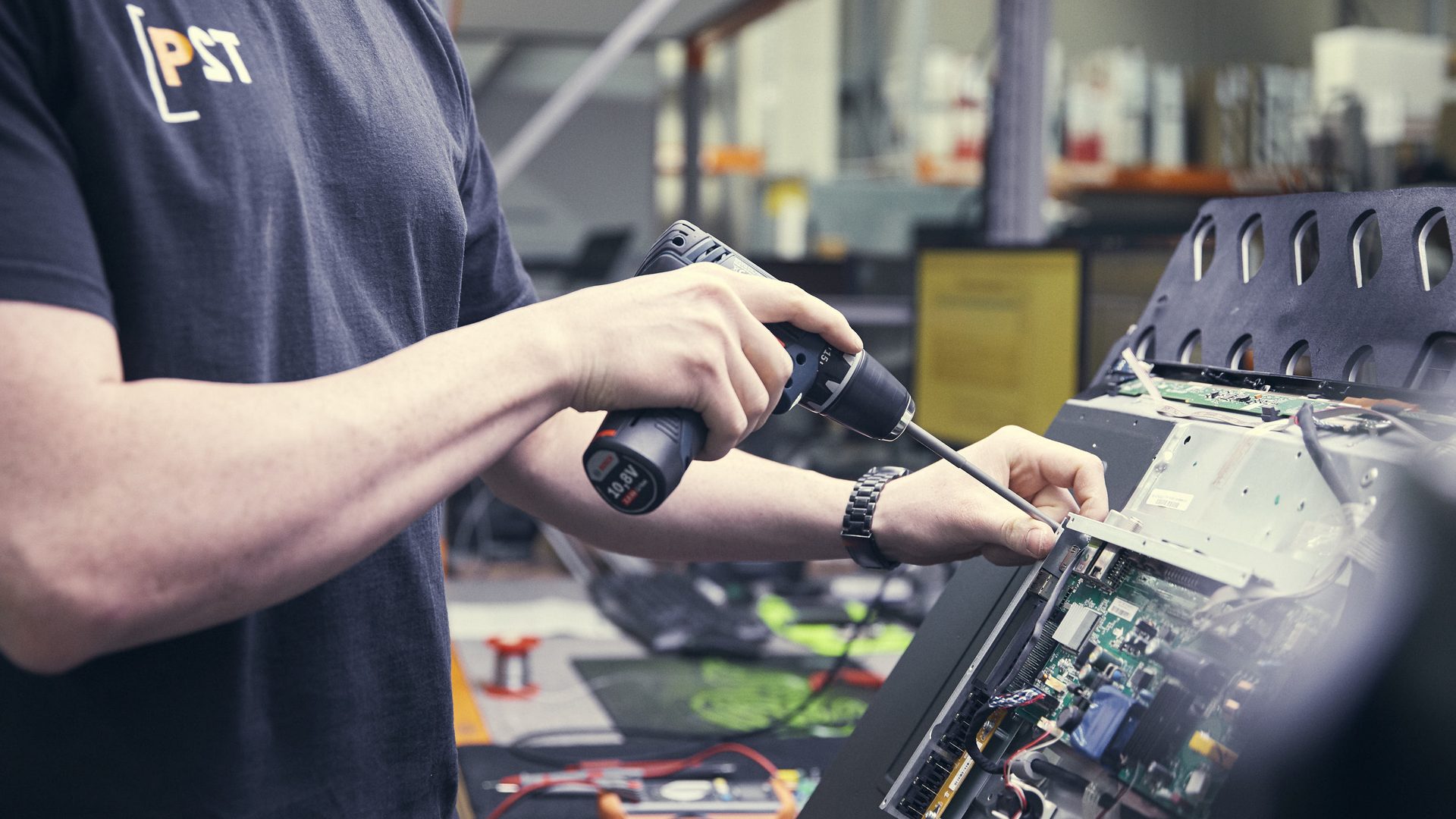
Manufacturers do not have to carry out repairs themselves. The Directive expressly allows them to subcontract repairs (Art. 5(1)). According to the explanatory memorandum, the manufacturer is then liable for its partner as for its own fault (Section 278 BGB). The same applies to importers and distributors who step in for a manufacturer based outside the EU: they do not have to perform the repair themselves either. The obligation stays with them, but a service provider can supply the workbench.
Your contract with the partner should therefore cover the scope of services, turnaround times, the pricing logic for the "reasonable fee", spare-parts supply and documentation that lets you prove compliance later. Separately, consumers remain free to have their goods repaired by any repairer they choose (Art. 5(8) of the Directive).
PST as your operational partner
PST has provided after-sales service for manufacturers and retailers for more than 25 years, with over 90 employees and more than 500,000 service cases a year at its site in Heiligenhaus, Germany. PST can operate defined repair, spare-parts, logistics and documentation processes, provided that scope, authorisation and responsibilities have been agreed. Whether and to what extent your products fall under the manufacturer obligation should be clarified with legal counsel beforehand. For an overview of our services, see our Right to Repair page. To reach the right contact person, use our contact form.
This article reflects the legal situation in Germany as of 3 October 2026 and does not constitute legal advice.